
7 MINUTE READ
The D2 Worldwide Study Was a Warning. We Only Heard Part of the Message.
More than 20 years ago, engineers at D2 Worldwide, sponsored by PC Matic, conducted one of the earliest public demonstrations showing the fire risks associated with lithium-ion batteries in consumer electronics. It was the infancy of YouTube, and millions of people watched the video in amazement. The demonstrations were compelling enough that some laptop manufacturers voluntarily issued recalls. At the time, it appeared the industry was paying attention to a growing concern.
Years later, PC Matic asked D2 Worldwide to revisit the issue. The conclusion was remarkably similar. The technology had evolved, battery adoption had accelerated, and lithium-ion cells had become embedded in an ever-expanding range of consumer products. Yet the fundamental problem remained. The risks associated with battery failure had not disappeared. In many respects, they had simply spread across a much larger ecosystem.
Today, those risks show up in places few people anticipated twenty years ago. Landfill fires, recycling facility fires, and garbage truck fires are increasingly linked to improperly discarded lithium-ion batteries. Communities bear the costs. Waste management organizations face growing operational challenges. Workers are exposed to unnecessary danger. These incidents often generate headlines for a few days before fading from public attention, only to be replaced by the next fire and the next investigation.
The electronics industry deserves tremendous credit for innovation over the past two decades. We have delivered extraordinary advances in mobility, connectivity, productivity, and convenience. Billions of people carry powerful computers in their pockets and rely on rechargeable devices throughout their daily lives. What we have not done as effectively is think through the full lifecycle of the products we create. We have become exceptionally skilled at designing products for purchase and use, but far less intentional about designing systems for what happens after those products reach the end of their useful lives.
For years, the conversation surrounding lithium-ion batteries has centered almost entirely on safety. That focus is understandable. Fire risks deserve serious attention. However, after watching this issue evolve for more than two decades, I have come to believe that safety is only half the story.
Why We’re Looking at the Problem Wrong
The prevailing assumption is that used batteries are waste. That assumption influences everything from consumer behavior to public policy. Once a battery no longer powers a device, we tend to think of it as a disposal problem that needs to be managed as cheaply and efficiently as possible.
But that perspective ignores what is actually inside the battery.
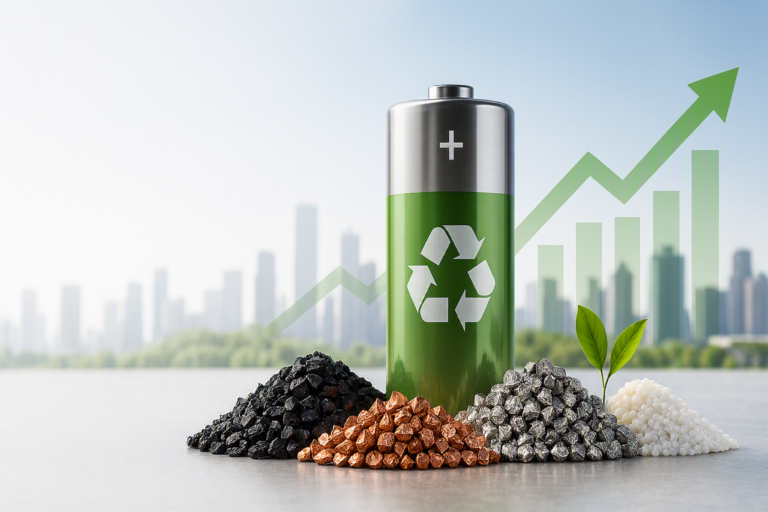
A lithium-ion battery is not simply a sealed container of stored energy. It is a collection of valuable materials that manufacturers spend enormous amounts of money acquiring, refining, transporting, and processing. Depending on the chemistry, those materials can include lithium, cobalt, nickel, copper, aluminum, manganese, and graphite. Several of these resources are becoming increasingly important to global supply chains as demand for batteries continues to grow across consumer electronics, energy storage systems, and electric vehicles.
Viewed through that lens, the current situation becomes difficult to justify. The same battery capable of causing a fire in a landfill may also contain materials that industries around the world are actively seeking to obtain. We are simultaneously worried about these batteries ending up in the wrong place while overlooking the value they contain.
Imagine if every discarded battery were viewed not as garbage, but as a small repository of recoverable resources. The conversation changes immediately. Battery collection becomes more than a waste management issue. It becomes a supply-chain issue. Battery recycling becomes more than an environmental initiative. It becomes a resource recovery business. Proper disposal becomes less about avoiding problems and more about preserving value.
This is why I believe the fire problem and the recycling problem are really the same problem viewed from different perspectives. Every battery that ends up in a landfill, recycling facility, or garbage truck represents both a safety failure and a recovery failure. We are increasing risk while simultaneously throwing away materials that required significant economic and environmental investment to produce in the first place.
The Opportunity Hiding in Plain Sight
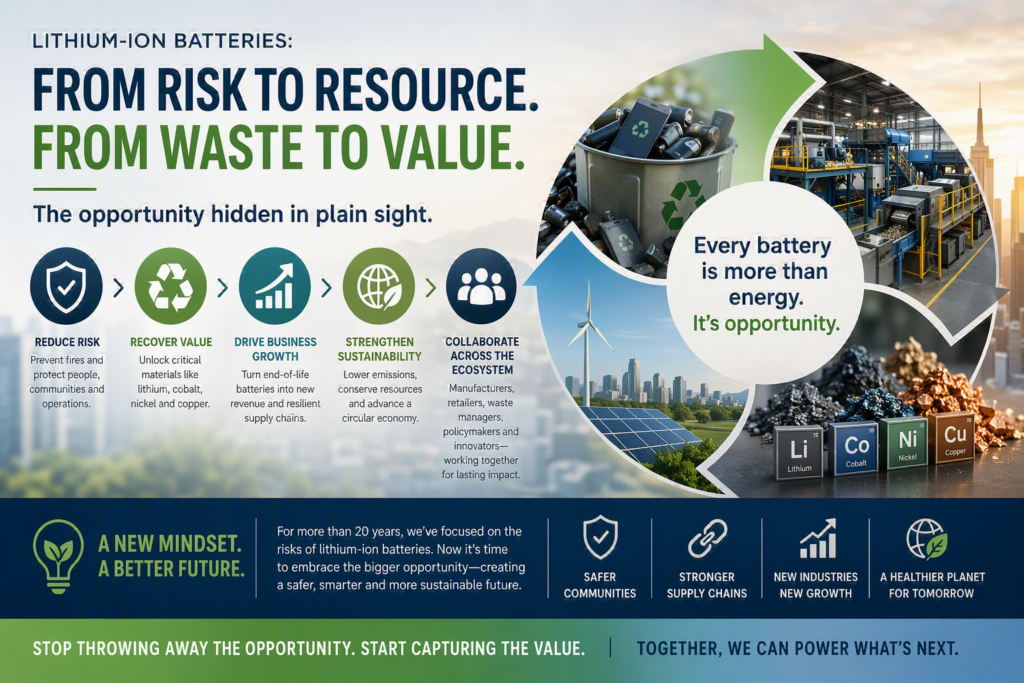
The encouraging news is that a growing number of companies have already begun recognizing this opportunity. Around the world, organizations are investing heavily in technologies designed to recover lithium, cobalt, nickel, copper, and other materials from spent batteries. Advances in recycling processes are making recovery more efficient, more economical, and more attractive than it was even a few years ago. What was once viewed primarily as a disposal cost is increasingly being viewed as a source of future value.
Perhaps even more interesting is the ecosystem developing around battery recovery. The opportunity extends well beyond large-scale recycling facilities. Businesses are emerging to support battery collection, storage, transportation, disassembly, material processing, and second-life applications. Entrepreneurs are exploring ways to build local and regional networks capable of capturing value that is currently being lost. In many cases, the greatest opportunity may not be extracting lithium from batteries, but simply creating the infrastructure needed to ensure batteries are collected safely and efficiently in the first place.
This shift in thinking also changes the discussion about responsibility. We cannot simply push the problem onto consumers and expect better outcomes. Consumers did not design these products. Most have little understanding of the battery chemistries inside the devices they use every day. They did not create a disposal system that is often confusing, inconvenient, and inconsistent from one community to another. Asking consumers alone to solve the problem is unlikely to produce meaningful change.
Real progress will require collaboration across the entire ecosystem. Manufacturers can improve battery labeling and design products that are easier to disassemble and recycle. Retailers can participate in collection programs. Waste management organizations can continue developing safer handling practices. Policymakers can create standards that encourage recovery while reducing risk. Most importantly, all of these stakeholders can begin viewing end-of-life batteries not merely as a waste stream, but as a resource stream.
For more than twenty years, the discussion around lithium-ion batteries has been dominated by concerns about what could go wrong. Those concerns remain valid and deserve continued attention. Yet focusing exclusively on risk may cause us to miss the larger opportunity sitting directly in front of us.
The materials have value. The technology exists. The business models are beginning to emerge. The environmental benefits are clear, and the safety benefits are undeniable.
The question is no longer whether we can solve this problem. The question is whether we are willing to stop treating used batteries like garbage and start treating them as one of the most valuable recoverable resources hiding in plain sight. If we make that shift, we will do far more than reduce fires. We will create an entirely new industry dedicated to recovering the materials that power the modern world.
Frequently Asked Questions (FAQs)
Q: What are the fire risks of improperly disposed lithium-ion batteries?
A: Improperly discarded lithium-ion batteries can become damaged, punctured, or exposed to heat, increasing the risk of thermal runaway and fire. These fires are increasingly linked to landfills, recycling facilities, and garbage trucks, creating safety concerns for workers, communities, and waste management organizations.
Q: Why are used lithium-ion batteries considered valuable resources?
A: Lithium-ion batteries contain materials such as lithium, cobalt, nickel, copper, aluminum, manganese, and graphite. Many of these materials are in high demand for manufacturing new batteries and other technologies, making battery recovery an important opportunity for resource conservation and supply-chain support.
Q: How does battery recycling help solve both safety and environmental challenges?
A: Battery recycling reduces the likelihood of fires caused by improper disposal while also recovering valuable materials that would otherwise be lost. By treating end-of-life batteries as recoverable resources rather than waste, organizations can improve safety outcomes and support more sustainable material use.
Q: Who is responsible for improving lithium-ion battery disposal and recovery?
A: Addressing the issue requires collaboration across manufacturers, retailers, waste management organizations, policymakers, and consumers. Manufacturers can improve product design and labeling, retailers can support collection programs, and communities can develop better recovery infrastructure to make proper disposal easier and safer.
Q: What opportunities are emerging in the lithium-ion battery recovery industry?
A: New opportunities are developing in battery collection, storage, transportation, disassembly, material recovery, and second-life battery applications. As recycling technologies improve and demand for battery materials grows, businesses are finding new ways to capture value from batteries that were previously viewed as waste.